

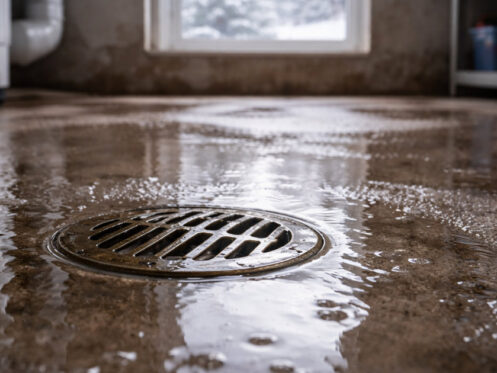
The condensate drain line helps get rid of the moisture that’s collected by your air conditioner. But when the line isn’t up to code, you might run into problems if your floor drain backs up, including water damage and accelerated mold growth. If your floor drain is backing up, the first step is to stop the flow and clear the drain. Then you can check your AC condensate drain line code compliance and make any necessary updates to prevent future problems.
What Is an AC Condensate Drain Line?
When your AC cools the air in your home, it removes both heat and moisture. That moisture condenses inside the AC unit and drips out into the AC condensate drain line, which carries the water out of your home.
The endpoint of condensate varies. In some houses, the pipe connects to your plumbing, so the excess moisture drains into the sewer system, and in others, it empties the condensate outside. Sometimes the line ends right over a floor drain, so water can drip out continuously.
If your condensate line empties into a floor drain, backups can be a big problem.
What to Do if Your Floor Drain Is Backing Up
While your AC condensate drain line probably won’t cause a floor drain to clog, it can be affected by backups.
Before you investigate, take these steps to deal with an overflowing floor drain:
- Turn off your AC. Disconnect the power to the AC to stop the flow of condensate. That way, you don’t need to deal with more moisture around the floor drain. If you think you might have a plumbing emergency on your hands, you can also try to contain the leak, turn off nearby electronics and take photos for insurance purposes.
- Smell the floor drain. If you notice a strong sewage odor or see sewage backup in the basement, call a professional plumber immediately. This could point to a major issue with your home’s plumbing or the main sewage line, which poses a significant hazard.
- Clear physical blockages. Put on gloves and scoop away any debris that’s collected around the floor drain. Once you clear the drain and the area around it, check to see if the water starts draining.
- Check the condensate drain line for clogs. Pour white vinegar into the top of your AC condensate drain line. If nothing comes out of the end near the floor drain, there might be a blockage in the line. When this happens, the AC drain pan can overflow and wash debris into the floor drain. You can use a shop vacuum to remove clogs.
- Remove clogs in the floor drain. If your condensate line is clear, you might be dealing with a clogged drain. You can try a few solutions, including a drain snake or a combination of baking soda and vinegar. If you have a shop vac, remove the drain cover and use the vacuum to suck out the clog.
Once everything starts draining normally again, it’s time to figure out what’s causing the problem. If you can’t find a clog and the drain is still backing up, it’s a good idea to call a plumber.
Why Does AC Condensate Drain Line Code Compliance Matter When a Floor Drain Backs Up?
If your AC condensate drain line is located near your floor drain, drain clogs or sewer line backups can affect your AC. And if the condensate drain line isn’t up to code, you might have even bigger problems.
For example, many codes state that your condensate drain line can’t be directly connected to a floor drain; instead, it needs an air gap. This space helps ensure that if the floor drain backs up, dirty wastewater or sewage is less likely to force its way into the condensate line and affect your AC system.
If your drain isn’t up to code, it could allow sewage or sewer gases to contaminate your AC and your home. Specific code requirements can vary by your city and state and may depend on the type and location of your AC.
Before you call a plumber, you can look for common AC condensate drain line code issues, such as:
- Incorrect pipe sizes: In many areas, your AC condensate line must meet a minimum standard for the inside diameter. If your drain line is too narrow, it could cause clogs or backups.
- Shallow slope: Many codes state a minimum slope for your AC condensate drain line. For example, in some areas, the line might need to drop a minimum of 1/8 inch for every 1 foot of pipe. A slope that’s too shallow is a common AC condensate drain line code violation that could prevent water from draining effectively.
- Missing HVAC float switch: This device automatically turns off your AC if there’s a backup in the condensate drain line, helping you avoid water damage and other issues. Some areas require one or more, depending on the location of your AC condensate drainage lines.
Because of variations in plumbing and building codes, it’s not always easy to determine if your AC condensate draining is compliant. If you’re not sure, consider calling a plumber for an inspection. They can check for code compliance and help you determine why your floor drain is backing up.
Get Help With AC Condensate Drain Line Issues and Floor Drain Backups
If you’re in the Chicagoland area, the Duane Blanton team can help with floor drain backups and help you bring your AC condensate drain line up to code. Schedule an appointment online or call us for emergency service at (815) 219-4389.